




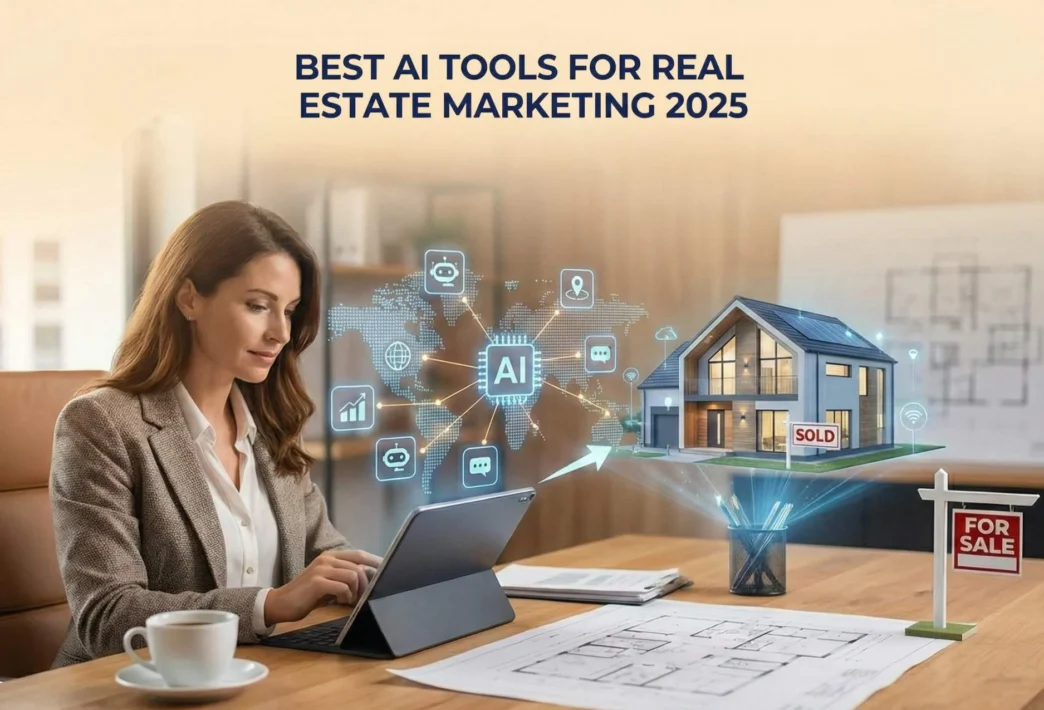
AI has moved beyond experimentation in real estate. In 2026, the agents, teams, and brokerages seeing consistent growth are those using real estate AI tools to streamline marketing execution, not replace human expertise. The real advantage comes from choosing the best AI for real estate that fits into daily workflows, listing promotion, lead handling, follow-up, and ongoing visibility.
This article breaks down how modern real estate marketing tools powered by AI are being used in practice, how they differ from generic platforms, and how to assemble a stack that improves speed, consistency, and conversion without unnecessary complexity.
What makes the best AI for real estate marketing in 2026?
The best AI for real estate marketing in 2026 is defined by workflow impact, tools that automate execution, reduce response time, and improve consistency across marketing channels. In real estate, AI value is measured by outcomes rather than features. Tools that simply generate content without integration rarely move the needle. High-performing real estate AI tools connect marketing actions to lead capture, CRM updates, and follow-up workflows automatically.
Effective platforms are built with real estate constraints in mind, including local compliance, listing language standards, and buyer intent signals. Rather than producing one-off outputs, the best real estate marketing tool continuously supports the full marketing lifecycle, from listing launch to long-term lead nurturing.
How GoHighLevel Acts as the Marketing Automation Backbone for Real Estate
Marketing execution in real estate breaks down when leads arrive faster than agents can respond. This is why AI-powered CRM platforms play a central role in modern marketing stacks. GoHighLevel is commonly used as the automation backbone that connects marketing activity directly to follow-up and conversion.
Rather than functioning as a simple contact database, GoHighLevel links marketing actions—such as form fills, ad clicks, or open house sign-ins—to automated workflows. When a lead engages with a campaign, responses are triggered instantly, pipelines update automatically, and follow-up sequences continue without manual intervention.
In real estate marketing workflows, GoHighLevel is typically used to:
- Capture leads from landing pages, ads, and sign-in forms
- Trigger immediate SMS or email responses
- Route leads into the correct pipeline or agent queue
- Maintain consistent follow-up across long buying cycles
This ensures that marketing efforts don’t stop at visibility. Every campaign connects directly to structured follow-up, making GoHighLevel a foundational layer for agents, teams, and brokerages focused on scalability and consistency.
Using Virtual Staging AI to Improve Listing Marketing Performance
Visual presentation remains one of the strongest drivers of engagement in real estate marketing. While traditional staging and editing can slow down listing launches, AI-powered visual tools have changed how quickly properties can be brought to market. Virtual Staging AI is widely used to streamline this part of the marketing workflow.
Instead of coordinating physical staging or multiple revisions, agents can digitally stage listings as soon as photography is complete. This allows marketing campaigns to launch faster while maintaining consistent visual quality across listings.
Within real estate marketing stacks, Virtual Staging AI is commonly used to:
- Stage empty rooms for online listings
- Remove clutter or outdated furniture from photos
- Create visually consistent assets for ads and portals
- Reduce delays between photography and listing launch
By shortening the time between property readiness and public visibility, Virtual Staging AI supports faster campaign execution. It enhances marketing output without changing how agents price, position, or negotiate properties, keeping human decision-making central to the process.
How GoHighLevel and Virtual Staging AI Serve Different Roles in a Real Estate Marketing Stack
Modern real estate marketing relies on multiple AI tools working together rather than a single all-purpose platform. While both GoHighLevel and Virtual Staging AI help agents save time, they operate at entirely different stages of the marketing workflow.
The table below highlights how each tool contributes to a complete real estate marketing stack without overlapping responsibilities.
| Marketing Workflow Area | GoHighLevel | Virtual Staging AI |
| Primary Role | Marketing automation & CRM execution | Listing visuals & presentation |
| Stage of Use | After lead capture and during follow-up | Before and during listing launch |
| Core Marketing Function | Converts marketing activity into conversations | Improves visual appeal of listings |
| Typical Usage Frequency | Daily, across all campaigns | Per listing or campaign |
| Manual Work Replaced | Lead tracking, follow-ups, pipeline updates | Physical staging, photo re-edits |
| Impact on Marketing | Ensures speed, consistency, and response | Increases engagement and click-through |
| Best Fit For | Agents, teams, brokerages | Listing-focused agents and marketers |
How do real estate marketing tools use AI differently than generic platforms?
Real estate marketing tools apply AI with structured constraints, focusing on conversion, compliance, and timing rather than open-ended creativity. Generic AI platforms prioritize flexibility, but real estate requires precision. Real estate AI tools are designed to understand listing data, geographic relevance, and buyer behavior. This allows AI to trigger actions—such as follow-ups or ad delivery—based on real engagement signals rather than manual input.
Because of this, a real estate marketing tool doesn’t just generate content. It ensures that content is delivered to the right audience, through the right channel, at the right time, all while remaining compliant with industry standards.
Can AI replace real estate marketing teams or agents?
AI does not replace real estate professionals; it replaces manual execution, fragmented systems, and slow response times. In practice, AI acts as a force multiplier. It handles repetition and coordination while agents focus on relationship building, negotiations, and local market insight. Brokerages using real estate AI tools typically see improved onboarding, stronger brand consistency, and higher agent productivity without increasing headcount. Rather than removing roles, AI reshapes how work is distributed, allowing marketing teams and agents to focus on higher-value activities.
Core AI Tool Categories Every Real Estate Stack Needs
A functional real estate marketing stack relies on clearly defined tool roles:
- Lead Capture & Qualification: AI chat, forms, and landing pages that instantly route leads into a CRM
- Automated Follow-Up: AI-generated messaging triggered by inquiries, missed calls, or property views
- Content & Listing Enhancement: AI-assisted copywriting, virtual staging, and visual asset creation
Each category supports the next, creating a continuous marketing loop.
Practical AI Marketing Workflows for Real Estate
New Listing Launch Workflow
AI accelerates listing launches by generating descriptions, ad copy, and visuals, then distributing them across social, email, and paid channels within hours instead of days.
Open House Lead Nurture Workflow
Digital sign-ins feed directly into a CRM, triggering same-day AI follow-ups and long-term nurture campaigns based on engagement behavior.
Paid Ads Optimization Workflow
AI tests creative variations, reallocates budget based on performance signals, and routes new leads instantly into follow-up pipelines.
Comparing All-in-One vs Specialized AI Tools
All-in-One Platforms
Centralized data, fewer integrations, and strong automation make these ideal for teams and brokerages.
Specialized Tools
Focused capabilities and flexibility make them useful for agents with clearly defined workflows.
Most high-performing stacks combine both approaches.
Building the Right Real Estate AI Stack for Your Business
The best AI for real estate depends on business size and structure. Solo agents benefit most from automation and speed, while teams and brokerages prioritize routing, reporting, and consistency. Tool selection should always be driven by workflow needs rather than feature lists. A well-designed real estate marketing tool stack reduces friction, shortens response times, and improves lead conversion without increasing operational complexity.
Conclusion: Choosing the Best AI for Real Estate Marketing in 2026
In 2026, competitive advantage comes from execution, not experimentation. The most effective real estate AI tools are those embedded into daily marketing workflows, quietly improving speed, consistency, and outcomes.
The best AI for real estate doesn’t replace expertise—it amplifies it. When chosen intentionally, the right real estate marketing tool stack becomes a long-term asset that compounds results over time, aligning perfectly with how modern agents and brokerages operate.
FAQs
What is the best AI for real estate marketing in 2026?
The best AI for real estate marketing in 2026 is one that integrates automation, CRM, and content workflows to reduce manual effort and improve lead response times. Effectiveness depends on how well the tool fits your daily marketing process.
How do real estate AI tools help agents get more leads?
Real estate AI tools help agents capture, qualify, and follow up with leads faster through automated messaging, AI-driven landing pages, and behavior-based triggers that reduce missed opportunities.
Are real estate marketing tools with AI expensive to use?
Many real estate marketing tools offer tiered pricing, making AI accessible to solo agents as well as large brokerages. The real cost savings come from reduced labor and faster marketing execution.
Can AI handle real estate marketing without a CRM?
AI can generate content without a CRM, but its impact is limited. The strongest real estate AI tools work best when connected to a CRM that manages leads, follow-ups, and automation workflows.
Is AI safe to use for real estate marketing compliance?
Most real estate-focused AI tools are designed with compliance considerations in mind, such as listing language controls and structured templates. Agents should still review outputs before publishing.
Do real estate AI tools replace marketing assistants or coordinators?
AI does not replace marketing staff but reduces repetitive tasks like follow-ups, content formatting, and scheduling, allowing teams to focus on strategy and client relationships.
What is the difference between generic AI tools and real estate AI tools?
Generic AI tools focus on broad content generation, while real estate AI tools are built for listings, lead workflows, and local market relevance, making them more effective for real estate marketing.
How should agents choose the right real estate marketing tool with AI?
Agents should choose tools based on workflow fit, automation capabilities, and integration with existing systems rather than features alone. The best AI for real estate supports speed, consistency, and scalability.