






Property management has always been operationally heavy. Rent collection, maintenance coordination, and owner reporting require precision, consistency, and follow-through—yet most teams still rely on fragmented systems and manual effort. This is exactly where ai for property management delivers measurable value.
Rather than replacing property managers, AI strengthens operations by removing repetitive tasks, reducing errors, and enforcing consistent workflows. When applied correctly, real estate automation transforms property management from a reactive function into a scalable system. At Xalt Stack, we evaluate real estate tools based on how well they perform inside real-world workflows—not feature lists or hype.
How does AI for property management automate rent collection reliably?
AI automates rent collection by scheduling payments, issuing reminders, reconciling transactions, and flagging anomalies—reducing late payments and manual follow-ups.
In a modern rent workflow, once a lease is activated, AI handles the full payment lifecycle. Rent invoices are generated automatically, reminders are sent before due dates, and payments are processed through secure channels. Each transaction is logged, categorized, and reconciled without manual spreadsheet updates.
What makes ai for property management different from basic automation is pattern recognition. The system identifies recurring late payments, partial payments, or failed transactions and escalates only those exceptions. Property managers stop chasing every tenant and focus instead on resolving genuine issues.
For teams managing dozens—or hundreds—of units, this shift alone saves hours per week while improving cash flow predictability. This is foundational real estate automation, not an optional add-on.
How can AI streamline maintenance without increasing vendor costs?
AI centralizes maintenance requests, auto-classifies urgency, and routes work orders efficiently, reducing delays and repeat visits. Maintenance is one of the most time-consuming parts of property management. Without automation, requests arrive via calls, texts, emails, and portals—forcing staff to manually organize, prioritize, and assign tasks.
AI consolidates all maintenance requests into a single system. Submissions are automatically categorized by issue type, urgency, and property. Based on predefined rules, work orders are routed to approved vendors or internal teams, and progress is tracked in real time.
Over time, AI evaluates vendor performance using resolution time, cost trends, and repeat issues. This data-driven routing reduces unnecessary dispatches and prevents cost overruns—proving that real estate automation improves efficiency without inflating expenses.
Why does AI-driven reporting improve owner and investor trust?
AI-driven reporting improves owner and investor trust by delivering consistent, real-time financial visibility with fewer errors, clearer explanations, and standardized performance metrics.
AI changes reporting from a periodic administrative task into a continuous transparency system. Instead of owners waiting for end-of-month summaries, they gain ongoing access to reliable performance data backed by automated logic rather than manual interpretation.
Key reasons AI-driven reporting builds trust:
- Consistency across reporting periods
Reports are generated using the same logic, formats, and data sources every time, eliminating discrepancies caused by manual calculations or formatting changes. - Real-time visibility into performance
Owners and investors can view up-to-date rent collections, expenses, and maintenance costs without delays, reducing uncertainty and follow-up questions. - Reduced human error
Automated data aggregation and calculations significantly lower the risk of missed entries, incorrect totals, or outdated figures that undermine confidence. - Clear variance explanations
AI highlights deviations from budget or prior periods and explains why changes occurred, helping owners understand performance rather than question it. - Audit-ready documentation
Every data point is traceable to a source action—payments, work orders, or approvals—creating defensible records for audits, disputes, or compliance reviews.
From an operational standpoint, this level of clarity shifts conversations with owners from justification to strategy. For property managers and brokerages using ai for property management, reporting becomes a trust-building asset rather than a recurring friction point—one of the most impactful outcomes of modern real estate automation.
When should brokerages adopt AI for property management workflows?
Brokerages should adopt AI when manual processes begin to limit response time, accuracy, or portfolio growth. Many brokerages delay automation until problems become unavoidable. In reality, the ideal time to implement ai for property management is when systems still function—but strain is visible. Late rent reminders, slow maintenance responses, and delayed reporting are all indicators.
AI adoption works best incrementally. Start with rent collection, then maintenance, then reporting. This phased approach allows teams to adapt without disruption while building confidence in automated systems.
From a strategic perspective, brokerages that invest early in real estate automation gain operational leverage—allowing them to manage more units with the same staff while maintaining service quality.
Core automation workflows that replace manual property management
Automated rent collection and reconciliation
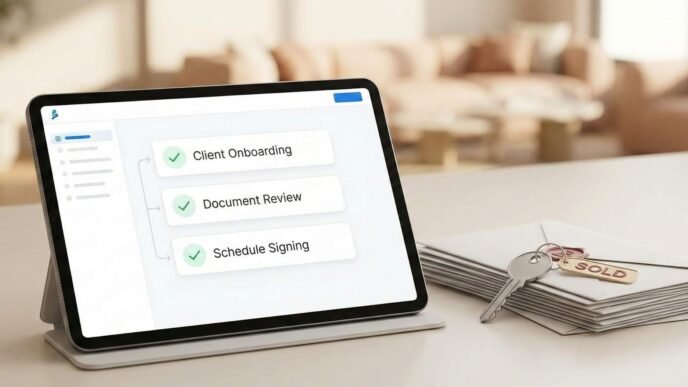
AI replaces manual invoicing, reminders, and payment tracking with a fully automated rent cycle. Once rent schedules are set, invoices are generated automatically, reminders are sent before due dates, payments are processed, and ledger entries are reconciled in real time. This workflow significantly reduces late payments and accounting errors while improving cash flow reliability.
Maintenance request intake and work order routing
Instead of managing maintenance through multiple communication channels, AI centralizes all requests into one system. Each request is classified by issue type and urgency, then automatically routed to the appropriate vendor or team. Status updates and completion logs are tracked automatically, reducing response times and improving tenant satisfaction.
Owner and investor performance reporting
AI-powered reporting replaces manual monthly summaries with live dashboards. Performance data is aggregated continuously, allowing owners to see income, expenses, and trends without waiting for reports. This transparency strengthens trust while saving property managers hours of manual compilation.
Compliance tracking and audit logging
Every action—rent notices, approvals, inspections, and updates—is automatically timestamped and logged. This replaces manual record-keeping and creates a reliable audit trail for legal, regulatory, or owner review purposes, strengthening operational accountability.
Manual vs AI-powered property management workflows
| Operational Area | Manual Approach | AI-Powered Approach |
|---|---|---|
| Rent collection | Emails, checks, spreadsheets | Automated billing, payments, reconciliation |
| Maintenance | Calls, inbox tracking | Centralized intake, smart routing |
| Reporting | Monthly manual reports | Real-time dashboards |
| Oversight | Reactive follow-ups | Exception-based management |
This comparison illustrates why ai for property management is increasingly considered essential infrastructure rather than a competitive advantage.
How GoHighLevel Supports Communication Automation in Property Management
Property management automation is only effective when communication is consistent, timely, and traceable. While many platforms handle rent, maintenance, or accounting, a separate automation layer is often needed to manage the volume of tenant and owner communication tied to those workflows. This is where GoHighLevel fits into modern property management operations.
Within property management environments, GoHighLevel is not used as a sales CRM. Instead, it functions as a communication automation system that supports operational events. Rent reminders, maintenance updates, inspection notices, and owner communications can all be triggered automatically based on predefined rules and property events. This reduces manual follow-ups while ensuring messages are sent consistently and on time.
Property managers typically use GoHighLevel to:
- Send automated rent reminders and payment confirmations
- Notify tenants about maintenance status and scheduling updates
- Deliver owner updates tied to reporting cycles or property events
- Track communication history across tenants, owners, and vendors
By centralizing these interactions, property managers gain visibility without relying on inboxes, spreadsheets, or manual reminders. Automation handles the routine messaging, while staff focus on exception handling, escalations, and relationship management. This distinction is critical for teams managing growing portfolios, where communication volume increases faster than headcount.
Used in this way, GoHighLevel strengthens ai for property management by enforcing consistency and accountability in communication—one of the most common failure points in large or distributed property operations.
Implementing AI for property management the right way
Successful implementation is less about technology and more about workflow design. High-performing teams:
- Map existing processes before automation
- Automate the highest-friction task first
- Define clear exception rules for human oversight
- Standardize outputs for owners and stakeholders
This playbook reflects real operational experience and aligns with Xalt Stack’s tool-first, utility-driven philosophy.
Conclusion: Building a scalable property management tech stack
AI is not about removing human involvement—it’s about removing inefficiency. When applied to rent, maintenance, and reporting, ai for property management enables teams to operate with consistency, transparency, and control. The advantage comes from selecting the right real estate tools and integrating them into practical workflows.
At Xalt Stack, we focus on systems that work under real-world conditions. The right automation stack doesn’t just save time—it creates the operational foundation for sustainable growth.
FAQs
What is AI for property management?
How does real estate automation help property managers?
Can AI reduce late rent payments?
Is AI-based maintenance management reliable?
AI improves reliability by centralizing requests, prioritizing urgency, and routing work orders based on predefined rules and past performance.
How does AI improve owner reporting accuracy?
AI pulls data directly from rent, expense, and maintenance systems, reducing human error and ensuring consistent, real-time reporting.
Are AI property management tools suitable for small portfolios?
Yes, even small portfolios benefit from AI by saving time, improving accuracy, and creating scalable systems early.
Does AI replace property managers?
No, AI supports property managers by handling operational tasks while humans focus on decisions, relationships, and oversight.
What should I automate first in property management?
Rent collection is typically the best starting point, followed by maintenance workflows and owner reporting for maximum impact.