





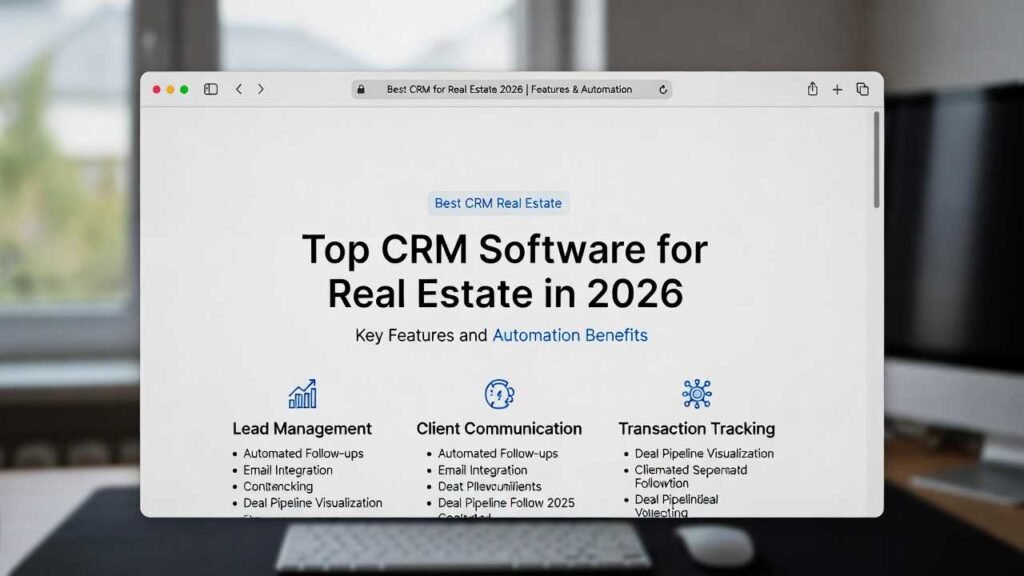
The definition of the best crm for real estate is changing rapidly. In 2026, CRMs are no longer judged by how many contacts they store, but by how effectively they automate operations, protect leads, and scale alongside modern real estate businesses. Agents, teams, and brokerages now operate in an environment where speed, consistency, and data-driven decision-making determine who wins listings and closes deals. This article outlines exactly what the best crm for real estate must deliver in 2026, using real-world workflows and objective evaluation principles from Xalt Stack.
What defines the best crm for real estate in 2026?
The best crm for real estate in 2026 is a system that centralizes data, automates follow-up, and enforces consistent workflows across the entire sales lifecycle. Modern real estate businesses generate leads from multiple sources simultaneously—paid ads, referrals, IDX websites, social media, and open houses. Without a centralized system, these opportunities fragment quickly. The best crm for real estate unifies all touchpoints into a single source of truth, giving agents and managers complete visibility.
In 2026, CRM value is measured by execution. Systems must trigger instant responses, assign tasks automatically, and move deals through defined stages without relying on memory. This operational discipline is what separates scalable businesses from reactive ones.
Which real estate crm features are no longer optional?
Core real estate crm features in 2026 include automated lead capture, multi-channel communication, pipeline visibility, and performance tracking. Real estate crm features have matured from “nice-to-have” add-ons into baseline requirements. Automated lead capture ensures no inquiry is missed, regardless of source. SMS, email, and call tracking must work together to create a complete communication record. Pipeline visibility is equally critical. Agents need to see where every opportunity stands, while team leaders require insight into stalled deals and response times. The best crm for real estate transforms raw data into actionable clarity without adding complexity.
How does real estate automation change daily agent workflows?
Real estate automation removes repetitive tasks, reduces response delays, and ensures every lead receives consistent engagement. In practical terms, automation reshapes the workday. Instead of manually sending follow-up texts or remembering callbacks, agents rely on workflows that execute automatically. New leads receive instant acknowledgment, reminders are scheduled, and long-term nurture campaigns run in the background.
This shift has a measurable impact. Faster response times improve conversion rates, while consistent follow-up increases trust with buyers and sellers. The best crm for real estate uses automation not to replace agents, but to amplify their effectiveness.
Can one CRM scale from solo agents to brokerages in 2026?
Yes, but only if the CRM is built for scalability, role-based access, and workflow flexibility from the start. Many CRMs perform well for solo agents but fail when teams grow. In 2026, scalability is a defining characteristic of the best crm for real estate. Systems must support shared pipelines, user permissions, reporting, and standardized processes without forcing costly migrations.
For brokerages, this scalability extends to recruiting workflows, performance dashboards, and compliance tracking. A CRM that cannot adapt across business stages becomes a bottleneck rather than an asset.
Real-world workflow comparison: manual vs automated CRM
Workflow Area | Manual Process | Modern Automated CRM |
Lead capture | Multiple inboxes | Centralized system |
First response | Delayed | Instant automation |
Follow-up | Inconsistent | Scheduled workflows |
Pipeline tracking | Spreadsheets | Visual deal stages |
Scalability | Limited | Designed for growth |
This comparison highlights why real estate automation is foundational to modern CRM performance.
Core capabilities every 2026-ready CRM must support
- Unified lead capture across all channels
- Automated SMS and email follow-up
- Customizable deal pipelines
- Task and reminder automation
- Reporting on response time and activity
These capabilities represent the baseline for the best crm for real estate, not advanced features.
Tools section: where GoHighLevel fits into a 2026 real estate stack
Among modern platforms, GoHighLevel is frequently used by forward-looking real estate businesses because it consolidates CRM functionality with advanced automation.
GoHighLevel functions as:
- A centralized CRM for leads and deals
- An automation engine for follow-up and reminders
- A communication hub for SMS, email, and calls
Its flexibility allows agents, teams, and brokerages to design workflows that reflect real operations rather than forcing predefined templates. From a Xalt Stack perspective, this adaptability aligns with how the best crm for real estate must operate in 2026.
Common mistakes agents make when evaluating CRMs
Many professionals choose a CRM based on brand familiarity or short-term pricing. Others underestimate the importance of automation depth or overestimate how much manual discipline they can maintain. The result is often CRM abandonment within a year. The best crm for real estate succeeds because it enforces good habits automatically and reduces cognitive load rather than adding it.
How Xalt Stack evaluates the best crm for real estate
Xalt Stack evaluates platforms through workflow performance, not marketing claims. Criteria include lead capture reliability, automation execution, scalability, and total cost of ownership over time. CRMs that reduce lead leakage, simplify operations, and support growth without constant reconfiguration score highest. Trust is built through repeatable outcomes, not feature lists.
Conclusion: building the right CRM foundation for 2026
In 2026, the best crm for real estate is no longer optional infrastructure—it is the foundation of competitive advantage. Systems that combine advanced real estate crm features with real estate automation allow professionals to respond faster, follow up consistently, and scale without chaos.
Xalt Stack’s position is clear: choose a CRM that works the way your business actually operates, not the way software demos suggest it should. When automation runs quietly in the background, agents and teams can focus on what drives results—relationships, expertise, and execution.
The right CRM is not just a tool. It is the operating system for modern real estate success.
FAQs
What makes the best CRM for real estate in 2026 different from older CRMs?
The best crm for real estate in 2026 focuses on automation, speed, and scalability rather than simple contact management. Modern CRMs act as operational systems that enforce follow-up, track pipelines, and support growth across agents, teams, and brokerages.
Which real estate CRM features are essential going into 2026?
Essential real estate crm features include automated lead capture, SMS and email follow-up, visual deal pipelines, task automation, and performance tracking. These features ensure consistency and reduce lead loss as volume increases.
How important is real estate automation in a modern CRM?
Real estate automation is critical because it removes manual follow-up, reduces response delays, and ensures every lead receives consistent engagement. Automation directly impacts conversion rates and operational efficiency.
Can one CRM work for solo agents, teams, and brokerages?
Yes, but only if the CRM is built to scale. The best crm for real estate supports solo workflows while offering role-based access, shared pipelines, and reporting as the business grows.
Why do many agents abandon their CRM within a year?
Most agents abandon CRMs because the system relies too heavily on manual discipline or lacks automation. Without enforced workflows, follow-ups become inconsistent and the CRM loses value over time.
How does automation improve lead conversion in real estate?
Automation improves conversion by enabling instant responses, structured follow-up sequences, and long-term nurture campaigns. Faster engagement and consistent communication significantly increase the chance of closing deals.
Is an all-in-one CRM better than using multiple tools?
All-in-one CRMs are often better because they reduce tool sprawl, data fragmentation, and monthly costs. The best crm for real estate consolidates lead management, communication, and automation into one system.
How does Xalt Stack evaluate the best CRM for real estate?
Xalt Stack evaluates CRMs based on real-world workflow performance, automation reliability, scalability, and total cost of ownership. Platforms are judged on measurable outcomes, not feature lists or brand recognition.