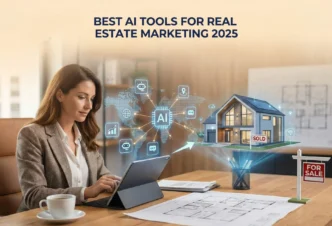






Real estate AI tools are becoming standard because they automate low-value tasks—marketing, follow-ups, and content—while allowing agents to focus on negotiations, relationships, and deal strategy.
In 2026, the conversation is no longer about experimenting with AI. It’s about operational survival. Agents face compressed margins, slower buyer decisions, and higher expectations for marketing quality. The most effective real estate AI tools are not replacing agents—they are removing friction from daily workflows.
What separates useful tools from hype is practicality. Agents adopt AI when it integrates into existing systems, saves measurable time, and directly impacts pipeline velocity. This is why CRM automation, visual enhancement, and short-form video tools dominate real-world usage instead of abstract “predictive” platforms.
The best AI for real estate in 2026 works quietly in the background. It schedules follow-ups, transforms raw content into polished assets, and upgrades listing presentation—without forcing agents to change how they sell.
Will AI Replace Real Estate Agents or Make Them More Valuable?
AI will not replace real estate agents; it increases the value of agents who use it by freeing time for high-trust, high-skill work that technology cannot replicate. The question, will ai replace real estate agents, continues to trend because the fear is understandable. However, adoption data tells a different story. Agents using real estate AI tools close more deals per year, not fewer, because they operate with leverage.
AI excels at speed and consistency. Agents excel at judgment, negotiation, and emotional intelligence. When combined, productivity compounds. For example, automated follow-ups ensure no lead is neglected, while the agent handles pricing strategy, objections, and deal structuring.
In practice, AI replaces tasks—not professionals. Agents who resist technology lose efficiency. Agents who adopt the best AI for real estate become harder to compete against, especially in listing-heavy or content-driven markets.
What Types of Real Estate AI Tools Deliver the Most ROI?
The highest-ROI real estate AI tools are those tied directly to revenue activities: lead follow-up, listing presentation, and marketing consistency. Across teams and solo agents, three categories consistently outperform others:
First, automation platforms that handle CRM tasks and nurture sequences reduce lead leakage. Second, visual AI tools that enhance listings shorten days on market. Third, content repurposing tools help agents stay visible across platforms without daily effort.
ROI is not measured by novelty. It’s measured by time saved per week and deals influenced per quarter. Tools that require heavy setup but don’t integrate into daily workflows often get abandoned. The most valuable real estate AI tools feel invisible once implemented.
How Should Agents Build a Practical AI Tech Stack in 2026?
Agents should build an AI tech stack around workflows, not features—starting with automation, then visuals, then content amplification. A practical stack begins with a core system of record. From there, agents layer tools that enhance marketing output and brand presence without increasing workload. The mistake many agents make is adopting too many disconnected platforms.
In 2026, winning stacks are intentionally small. Each tool must earn its place by either saving time or increasing deal flow. Integration matters more than raw capability, especially for solo agents and small teams.
How Agents Use GoHighLevel to Enforce Consistent Follow-Up at Scale
The most widely adopted form of real estate automation in 2026 is not content generation—it is follow-up enforcement. Missed responses, delayed replies, and inconsistent nurture remain the biggest causes of lost opportunities. This is why platforms like GoHighLevel have become foundational in daily agent workflows.
GoHighLevel is not used as a passive CRM. Agents rely on it as an execution layer that ensures communication continues even when they are unavailable. When a lead enters the system, automated responses trigger immediately, pipelines update automatically, and follow-up sequences continue until a prospect engages or exits the funnel.
In real-world usage, agents adopt GoHighLevel to:
- Eliminate delays between inquiry and first response
- Maintain long-cycle follow-up for buyers, sellers, and investors
- Segment pipelines by intent, asset type, or deal stage
- Prevent leads from stagnating during busy weeks
This becomes especially critical in ai in commercial real estate, where deals rarely fail outright—they fade due to silence. By automating timing and consistency, GoHighLevel protects momentum while leaving judgment, negotiation, and relationship management firmly in the agent’s hands.
Why Virtual Staging AI Has Become Standard in Listing-Centric Markets
Listing presentation is one of the most time-sensitive components of real estate marketing. Delays caused by physical staging, revisions, or vendor coordination often slow time-to-market. As a result, visual automation has become one of the fastest-growing categories within real estate AI tools. Virtual Staging AI is widely adopted for this exact reason.
Rather than replacing marketing strategy, virtual staging accelerates execution. Agents use it to transform raw listing photos into market-ready visuals without waiting days for staging or editing. This allows listings to go live faster while maintaining a clean, neutral presentation that performs well across portals and ads.
In practice, Virtual Staging AI is used to:
- Stage empty properties to help buyers visualize scale and layout
- Remove clutter or outdated furnishings from photos
- Standardize visual quality across multiple listings
- Reduce dependency on physical staging timelines
The result is not just aesthetic improvement, but operational efficiency. Faster listing preparation leads to earlier exposure, quicker campaign launches, and fewer bottlenecks in the marketing process—especially in listing-heavy environments where speed compounds results.
How These AI Tools Reduce Time Waste Across Core Agent Workflows
The most effective real estate AI tools in 2026 don’t compete with each other—they eliminate different bottlenecks in the same workflow. The table below shows how GoHighLevel and Virtual Staging AI are used together to remove friction from lead handling and listing execution.
|
Workflow Area |
GoHighLevel |
Virtual Staging AI |
|
Primary Use Case |
Follow-up & pipeline automation |
Listing visuals & presentation |
|
When It’s Used |
After a lead is generated |
Before or during listing launch |
|
Main Time Drain Removed |
Manual replies, reminders, tracking |
Physical staging delays |
|
Automation Focus |
Messaging, sequencing, pipeline movement |
Image staging and cleanup |
|
Typical Usage Pattern |
Daily, across all leads |
Per listing |
|
Outcome for Agents |
Faster responses, no lost leads |
Faster launches, stronger listing appeal |
Comparing AI Adoption: Solo Agents vs Teams
How Solo Agents Use Real Estate AI Tools
Solo agents rely on real estate AI tools to eliminate bottlenecks that typically slow individual operators, such as delayed follow-ups, inconsistent marketing, and manual content creation. By automating CRM workflows, listing descriptions, and social content, solo agents maintain a professional, always-on presence without hiring staff. For them, the best AI for real estate is measured by how much time it gives back each week while preserving a personal, relationship-driven sales approach.
How Teams and Brokerages Deploy AI at Scale
Teams and brokerages adopt real estate AI tools to standardize execution across multiple agents while maintaining brand control and operational visibility. AI-powered automation ensures leads are distributed evenly, messaging remains consistent, and marketing assets are deployed on schedule regardless of agent workload. At scale, AI becomes an enforcement layer—protecting process integrity and performance consistency rather than simply increasing individual productivity.
What to Avoid When Choosing Real Estate AI Tools
Not every AI platform adds value. Agents should be cautious of tools that:
- Require constant manual input to function
- Duplicate existing CRM features
- Focus on analytics without actionable outputs
- Lack clear integration paths
Adoption fails when tools increase cognitive load instead of reducing it.
Conclusion: AI Is the Advantage—If Used Correctly
In 2026, real estate AI tools are no longer optional—but they are not magic either. The agents who benefit most are those who treat AI as infrastructure, not shortcuts. Automation handles the repeatable. AI enhances presentation. Agents remain responsible for trust, expertise, and outcomes.
The question is no longer will AI replace real estate agents. The real question is which agents will use AI to replace inefficiency—and which won’t.
At Xalt Stack, the focus remains clear: practical tools, real workflows, and tech stacks that serve the business—not the other way around.
FAQs
What are real estate AI tools?
Real estate AI tools are software platforms that use automation and artificial intelligence to handle tasks like lead follow-up, listing marketing, content creation, and CRM management, helping agents operate more efficiently.
What is the best AI for real estate agents in 2026?
The best AI for real estate in 2026 depends on workflow needs, but tools that combine automation, marketing, and content—such as CRM platforms, AI copywriting, and visual enhancement tools—deliver the highest ROI